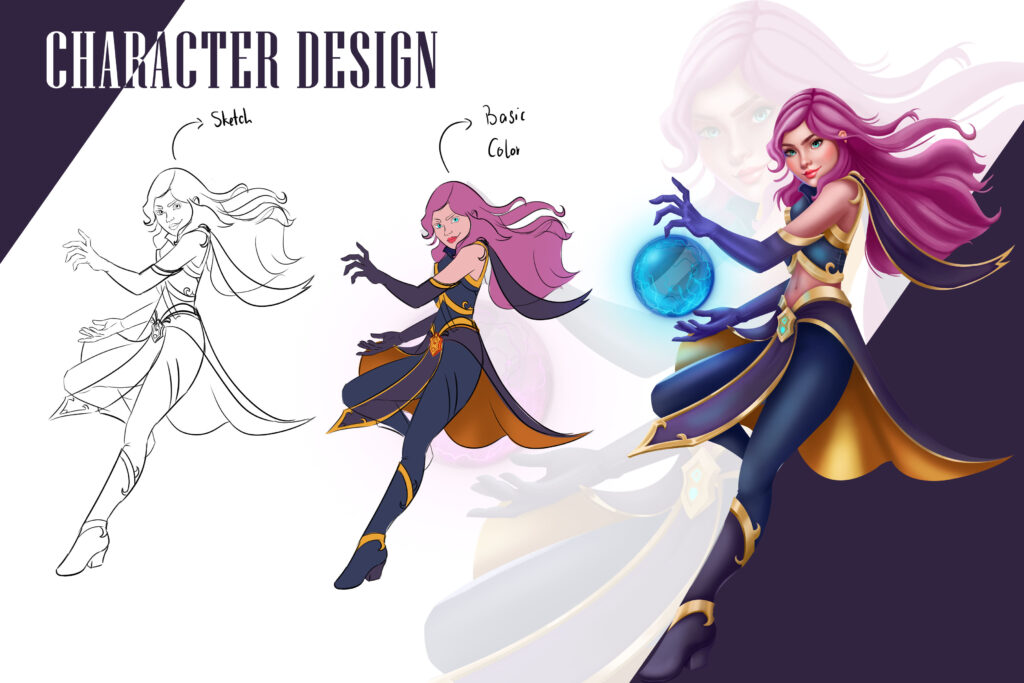
01 / Mechanics-Led Visual Semiotics
Focus: Investigating how 2D stylized aesthetics, silhouette psychology, and UI/UX interface systems translate core game mechanics into intuitive player mental models. Analyzing how visual affordances actively support narrative world-building, spatial clarity, and player retention.
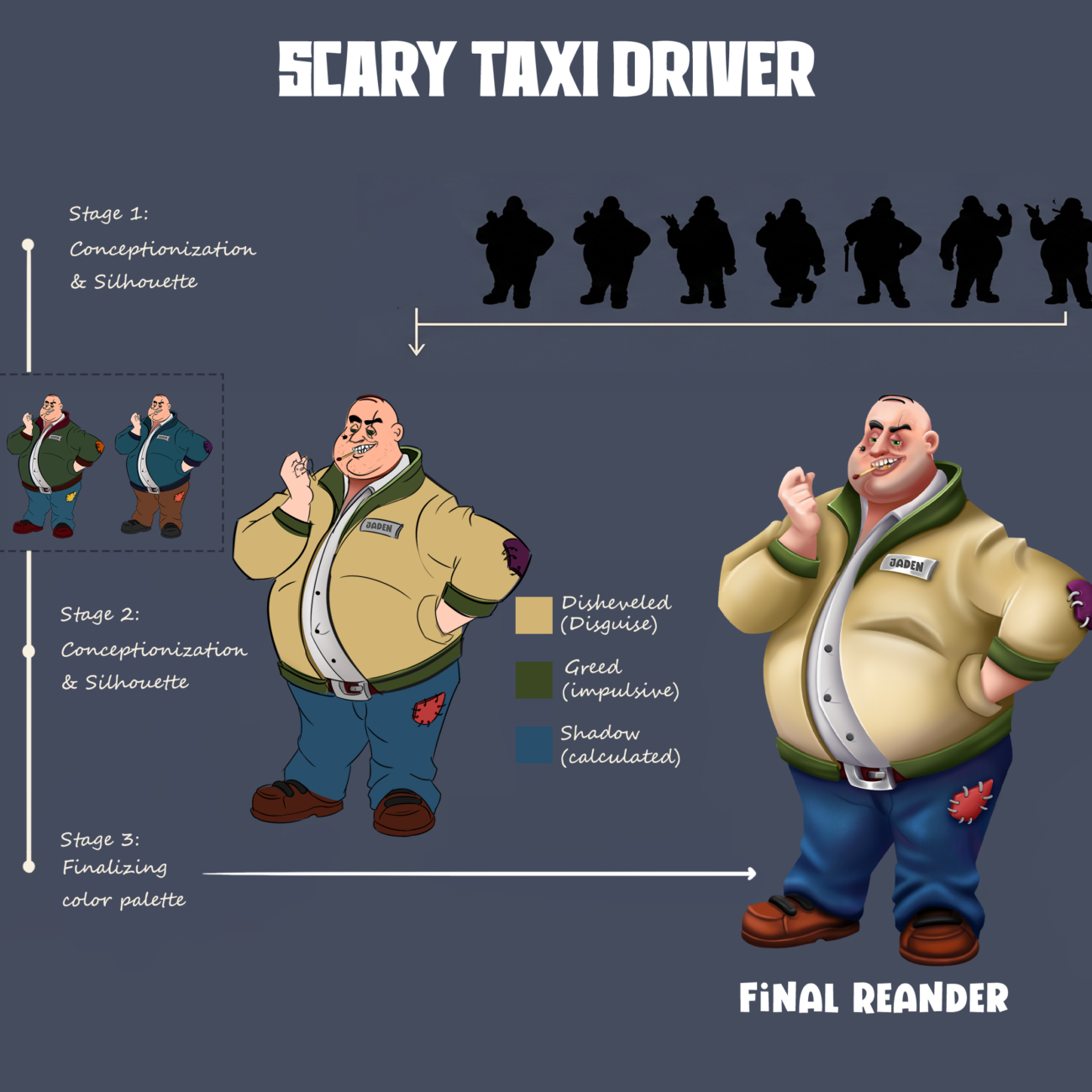
Challenge Abstract Trait Translation: Converted a sinister narrative archetype (a predatory driver) into an instantly recognizable, 3D-ready character concept.
Aesthetic Balancing: Managed the tension between projecting genuine narrative menace and adhering to the visual constraints of a stylized casual game.
Research Approach Visual Threat Mechanics:
Evaluated anatomical asymmetry, unhygienic signifiers, and exaggerated facial expressions to communicate volatility and threat.
Stylized Readability: Used exaggerated silhouettes, bold line art, and clean value blocking to ensure immediate visual recognition.
Color Psychology: Formulated a palette anchored in tones of neglect and decay (dirty olives, muddy beiges) contrasted with localized warm accents to signal danger.
Execution & DeliverablesForm & Expression:
Built geometric volume via grayscale value passes before color application; integrated signature details including an unhinged expression, gold tooth, facial scarring, and a matchstick tic.
Color System: Established a muted core palette alongside production colorway variations.
UI Optimization: Delivered a final circular portrait pass formatted for in-game UI integration.
Case Study: Stylized Reward Asset Pipeline (Nick and Tani Match Game)
Technical ChallengeContext & Mechanics:
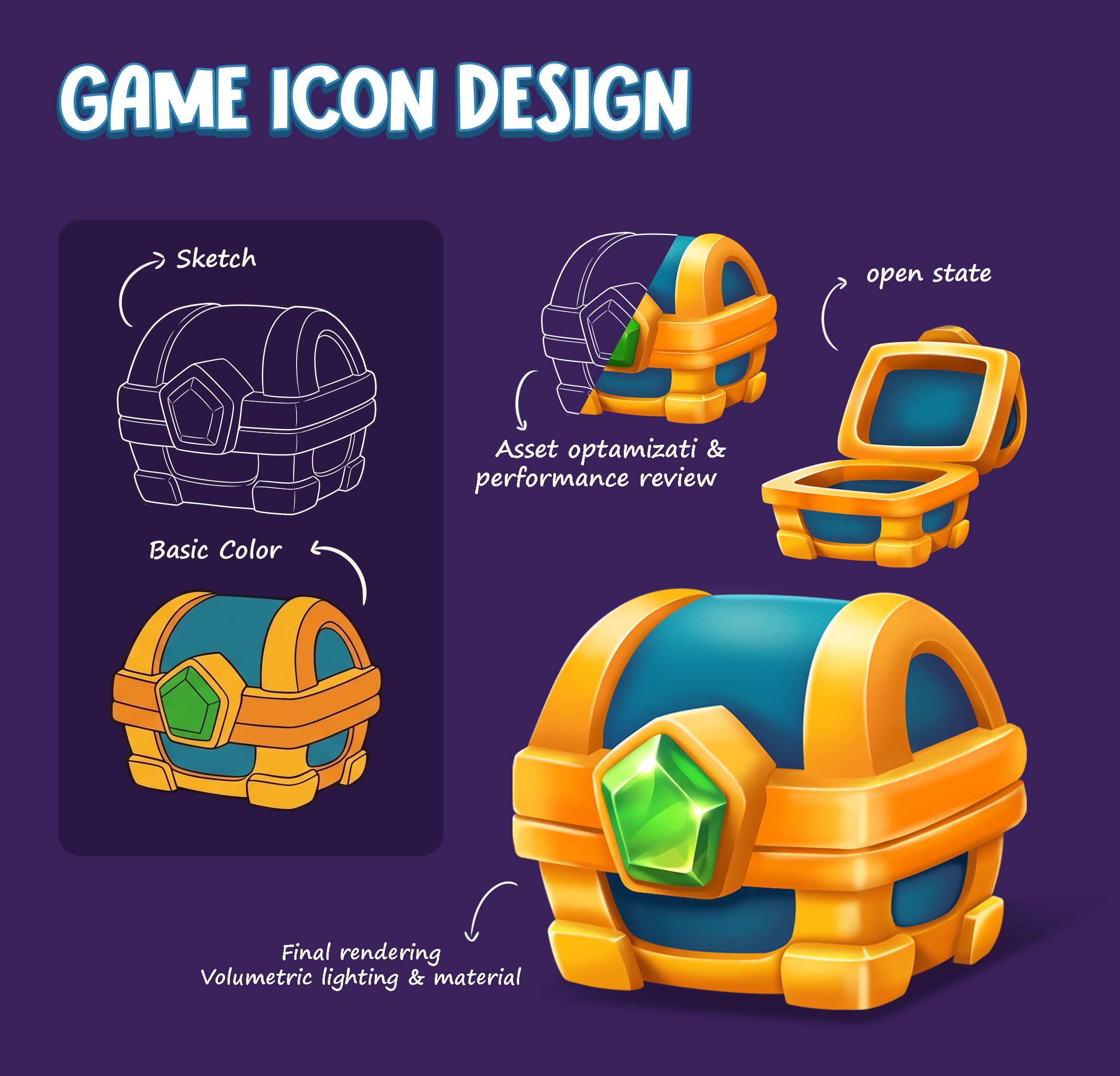
Developed for a tile-matching puzzle loop structurally analogous to Toy Blast, requiring immediate visual clarity within a fast-paced reward ecosystem.
Aesthetic Alignment: Translates core casual UI requirements into an Arabian fantasy world (inspired by Aladdin), balancing narrative thematic cues with high-readability mobile asset design.
Research & Pipeline ApproachForm & Silhouette: Utilizes bold line art, rounded volumes, and exaggerated proportions to maintain visual salience at smaller UI display scales.Color & Material Signifiers: Combines vibrant gold trim with rich teal body panels and an emerald core accent—leveraging high-contrast, jewel-tone palettes to reinforce immediate player feedback and value perception.
Production ExecutionOrthographic & Structural Drafting: Established clean vector line sketches defining mechanical hinge mechanisms, chest curvature, and locking iconography.
Color Blocking & Value Stratification: Applied flat base tones to lock in hue relationships prior to volumetric rendering.
Material Polish & UI Delivery: Rendered soft directional highlights, ambient occlusion, and metallic rim lighting to optimize for mobile screen contrast, completing both closed and opened states for interactive feedback loops.
Case Study 3: UI/UX & Interaction Design
Project Title:
Cognitive Player-Flow & Interface Architecture
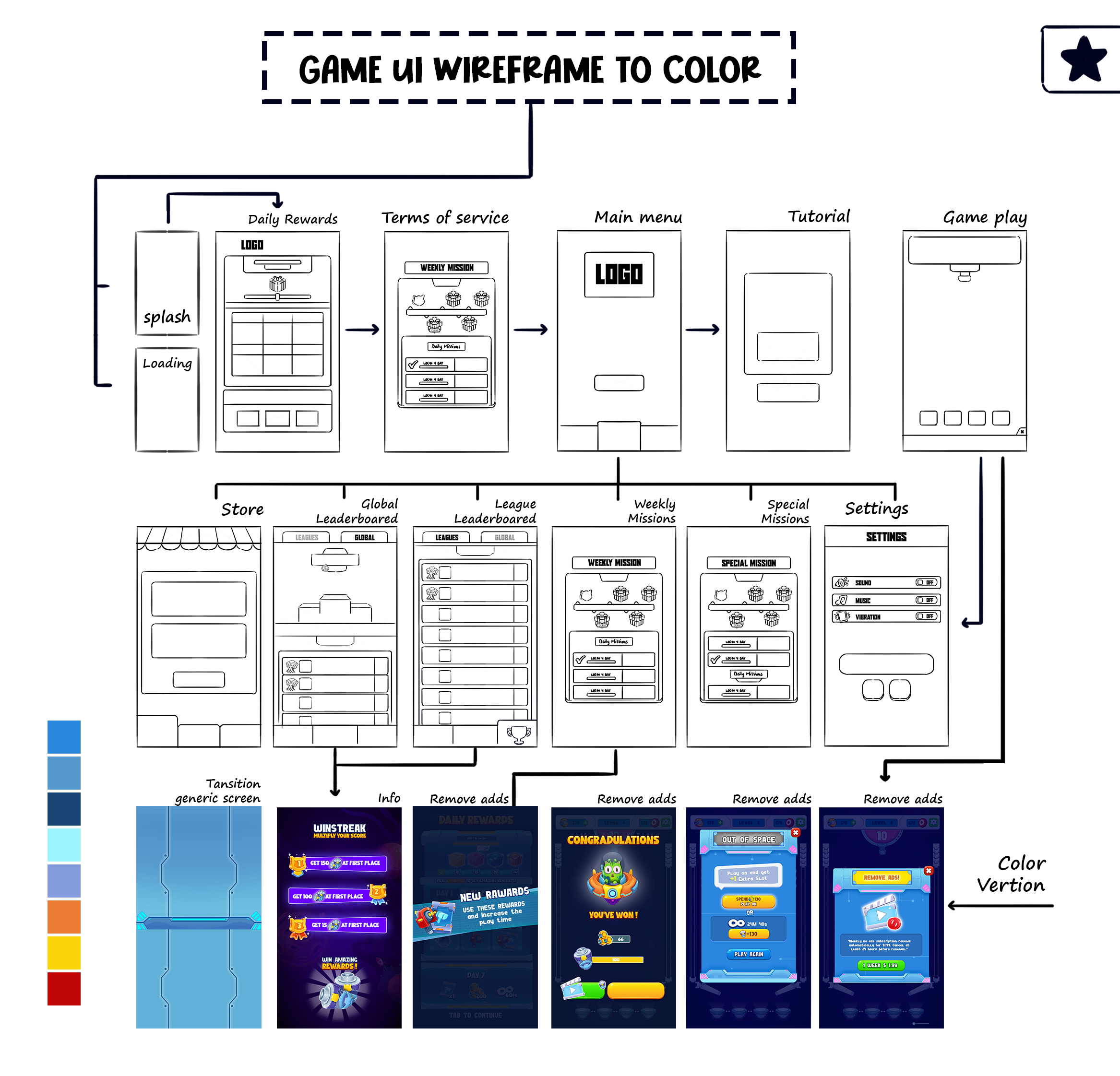
The Technical Challenge: Reducing cognitive friction for players in high-engagement mobile titles by establishing an intuitive interface pipeline across complex game systems—including shop screens, global leaderboards, mission logs, and settings menus.
The Research & Pipeline Approach: Mapping out extensive wireframe flows based on thumb-zone mapping and visual hierarchy laws (such as Fitts' Law and the Gutenberg Diagram). This framework serves as my standard end-to-end UI workflow during game production—systematically guiding the visual evolution from initial structural sketches to fully themed screen layouts.
The Execution & Deliverables: A multi-stage production breakdown demonstrating the complete transition from early low-fidelity UX wireframes and user interaction flowcharts to thematic color palette selection, spatial layout blocking, and final high-fidelity stylized vector UI components.
2D Concept Design, Stylization & Vector Art
Tools: Adobe Photoshop, Adobe Illustrator
Application: Core 2D concept art generation, character turnaround sheets, stylized environment assets, custom icon design, and vector typography.
UI/UX Prototyping & Interface Architecture
Tools: Figma, Adobe Photoshop, Adobe Illustrator
Application: Wireframe flowcharts, interactive player-flow prototyping, thumb-zone mapping, and high-fidelity mobile game UI design.
Engine Deployment, Motion & Real-Time Prototyping\
Tools: Unity Engine, Adobe After Effects
Application: Real-time asset integration, UI canvas layout testing, UI motion graphics, 2D asset animation, environment assembly, and spatial affordance validation.
My View:
I am always open to exploring new research methodologies, institutional collaborations, and creative pipelines. Please feel free to review my complete portfolio on the website, my academic achievements, and professional work timeline